Burhaana Rabbih and Self-Control: A Model of Sustainable Resistance to the Digital Moral Crisis
DOI:
https://doi.org/10.31943/afkarjournal.v9i1.3152Keywords:
Burhaana Rabbih, Self Control, Baumeister, Sustainable Resistance, Digital MoralityAbstract
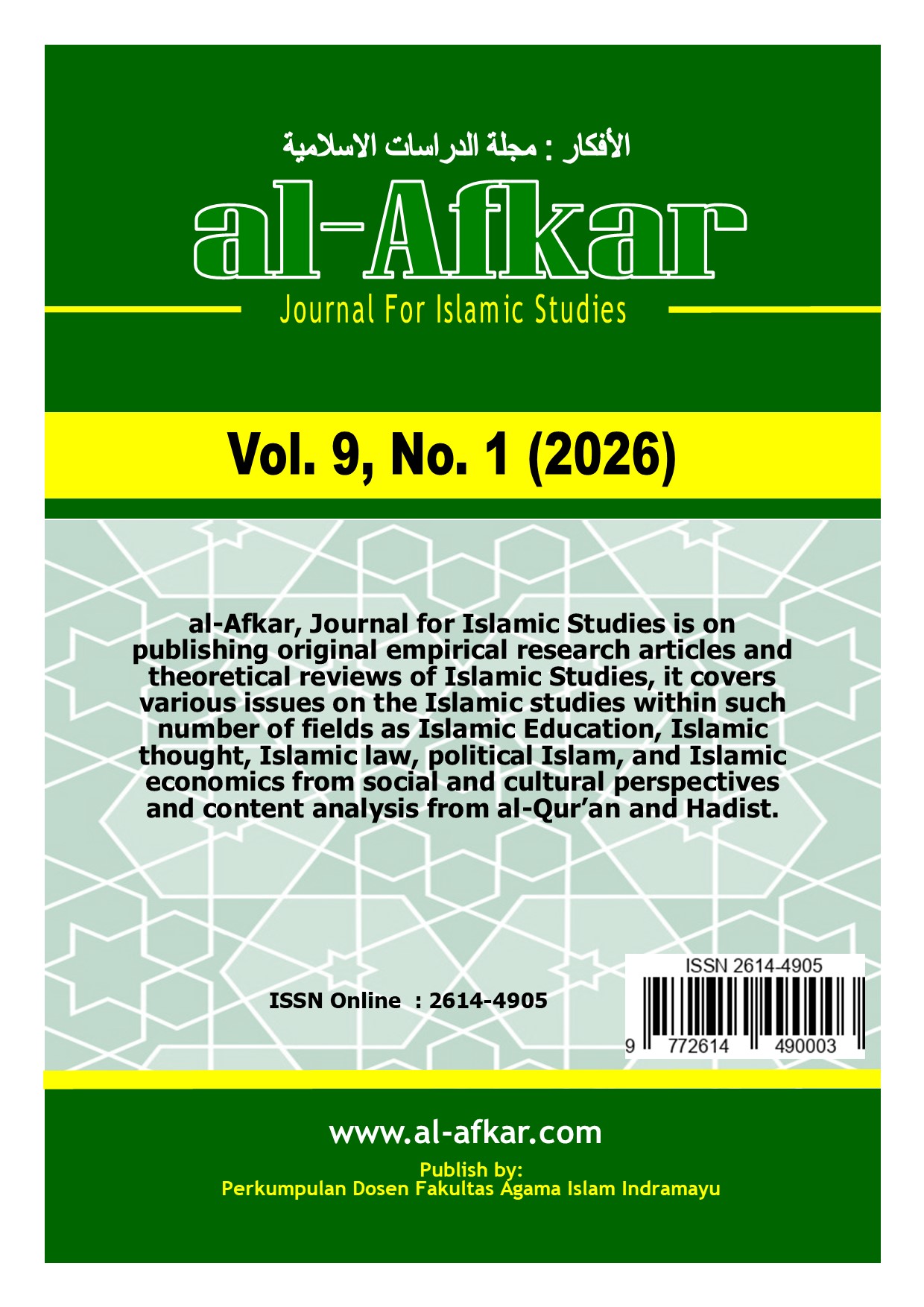
The development of digital technology has given rise to increasingly complex moral challenges, marked by increased impulsive behavior, weakened self-control, and the normalization of deviance through social media. This phenomenon demonstrates that conventional normative and psychological approaches have not been fully able to address the recurring and ongoing moral crisis. This article aims to examine the meaning of Burhāna Rabbih in Surah Yusuf verse 24 and integrate it with Baumeister's self-control theory to formulate a sustainable resistance model as a framework for moral resilience in the digital era. This research uses a qualitative approach with library and thematic interpretation (maudhu'i) methods, as well as an interdisciplinary analysis of Qur'anic studies and modern psychology. Data were obtained from the Qur'an, classical and contemporary commentaries, psychological literature from the past five years, and empirical reports related to digital moral phenomena. The results show that Burhāna Rabbih functions as a spiritual-psychological mechanism that strengthens moral standards, internal motivation, self-awareness, and volitional strength. The integration of this concept with Baumeister's self-control theory produces a sustainable resistance model that can explain moral resilience in a sustainable manner, not just situationally. This research contributes to the development of interdisciplinary thematic interpretations and offers an alternative approach to strengthening morals and self-control in the digital era.
Downloads
References
Baumeister, R. F., & Vohs, K. D. (2020). Handbook of Self-Regulation: Research, Theory, and Applications (3rd ed.). New York: Guilford Press.
Kementerian Komunikasi dan Informatika RI. (2021–2024). Laporan Pengendalian Konten Internet Bermuatan Negatif. Jakarta: Kominfo.
McCullough, M. E., & Willoughby, B. L. (2021). “Religion, Self-Regulation, and Moral Persistence.” Psychological Bulletin, 147(4), 347–375.
Hassan, N. (2021). “Spiritual Consciousness and Moral Behavior: A Qur’anic Perspective.” Journal of Islamic Ethics, 5(1), 55–78
Hassan, N. (2021). “Spiritual Consciousness and Moral Behavior: A Qur’anic Perspective.” Journal of Islamic Ethics, 5(1), 55–78.
Roudhotina, W. (2022). “Self-Control and Digital Temptation Among
Indonesian Youth.” Journal of Social Behavior Studies, 9(1), 41–63.
“Tafsir Ma‘ārif al-Qur’ān,” Maktabah Dār al-‘Ulūm. Vol. 12 (2025).
Ibn Katsir, Tafsir al-Qur’an al-‘Azim (Kairo: Dar al-Hadits, 2021).
Al-Mahalli, J., & Al-Suyuti, J. (2021). Tafsīr al-Jalālayn. Beirut: Dār al-Kutub al-‘Ilmiyyah
Wahbah Al-Zuhaili, Tafsir al-Munir (Damaskus: Dar al-Fikr, n.d.).
Quraish Shihab. (2020). Tafsir al-Mishbah: Pesan, Kesan, dan Keserasian Al-Qur’an. Jakarta: Lentera Hati.
Ahmad Mustafa. Al-Maraghi, Tafsir Al-Maraghi (Beirut: Dar al-Fikr, n.d.).
Pirutinsky, S. (2024). “Religious Coping and Digital Moral Behavior Among Emerging Adults.” Journal of Religion and Technology, 3(1), 15–37..
Rahmawati, Lady Eka. (2023). “Lebih Dekat dengan Metode Tafsir Maudhu’i; Kajian Tematik Atas Ayat-ayat Al-Qur’an.” Sanaamul Qur’an: Jurnal Wawasan Keislaman, 4(2), 163–173.
Baumeister, R. & Vohs, K. (2020). Self-Regulation. Social and Personality Compass, 1(2).
Naseem, A., Rahman, T., & Khatib, N. (2022). “Spiritual Practice and Metacognitive Moral Awareness.” Journal of Islamic Psychology, 7(2), 88–104..
Koenig, H. (2020). Religion and Mental Health: Research and Clinical Applications. San Diego: Academic Press.
Bandura, A. (2020). Moral Disengagement: How People Do Harm and Live with Themselves (Updated Edition). New York: Worth Publishers..
Baumeister, R. F., & Tierney, J. (2021). The Power of Self-Control in a Digital World
Harvard Business Review. (2020). “Why Social Media Reduces Self-Control: Behavioral and Neurological Evidence.” HBR Research Digest, 98(4), 44–59..
UNICEF Indonesia. (2022). Digital Behavior and Online Risk Report for Indonesian Adolescents. Jakarta: UNICEF Indonesia.
Fardouly, J., & Vartanian, L. R. (2021). “Social Media and Body Image Concerns.” Current Opinion in Psychology, 36, 1–5.
Kircaburun, K., et al. (2020). “Problematic Internet Use, Social Media Addiction, and Self-Control.” Journal of Behavioral Addictions, 9(1), 1–14.
Baumeister, R. F., Tice, D. M., & Vohs, K. D. (2021). “The Strength Model of Self-Regulation Revisited.” Perspectives on Psychological Science, 16(6), 1266–1282
McIntyre, C., & Van Tongeren, D. (2022). “Religion, Meaning, and Willpower: How Spirituality Enhances Volitional Strength.” Psychology of Religion and Spirituality, 14(3), 285–299.
Rothschild, Z., & Keefer, L. (2023). “Moral Awareness and the Role of Religious Cognition in Ethical Decision-Making.” Journal of Experimental Social Psychology, 102, 104–119.
Yaden, D., Newberg, A., & Vago, D. (2020). “The Psychology of Transcendent Motivation.” Nature Human Behaviour, 4(5), 567–578.
Van Tongeren, D. R., et al. (2021). Spirituality and Moral Endurance.
Downloads
Published
How to Cite
Issue
Section
License
Copyright (c) 2026 Muhammad Sulaiman Nuh, Rahmat Hidayat , Ahmad Syarif Hidayatullah

This work is licensed under a Creative Commons Attribution 4.0 International License.