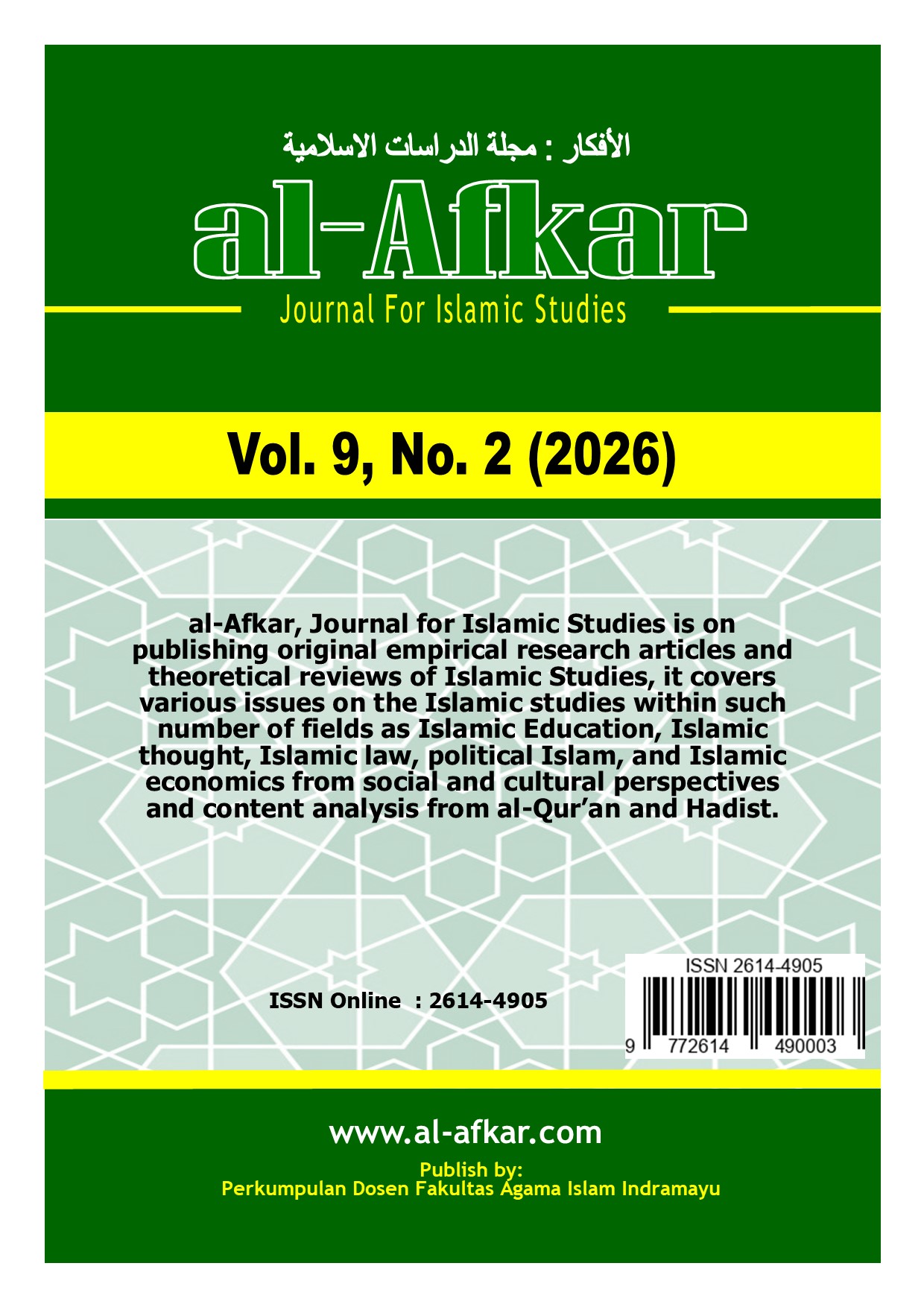
Spirituality and Ethics in Surah Al-Fajr: A Comparison of Al-Misbah's and Al-Azhar's Tafsirs
DOI:
https://doi.org/10.31943/afkarjournal.v9i2.3342Keywords:
Spirituality, Ethics, Surah Al-Fajr, Tafsir Al-Azhar, Tafsir Al-MisbahAbstract
This study examines the dimensions of spirituality and ethics in Surah Al-Fajr through a comparative study between Tafsir Al-Azhar by Buya Hamka and Tafsir Al-Misbah by M. Quraish Shihab. The main issue raised is how the messages of the Qur'an respond to the moral crisis and modern materialism. Using a qualitative method with a comparative interpretation approach, this study analyzes the interpretations of the two exegetes on key verses concerning divine oaths, the history of previous peoples, trials of sustenance, and the concept of peace of mind. The results show that both exegetes agree that faith is the core response to life's trials and emphasize that Islamic spirituality is inseparable from social responsibility. The fundamental difference lies in their interpretive orientation: Quraish Shihab in Tafsir Al-Misbah emphasizes a rational-contextual approach and linguistic analysis to correct the theological paradigm. Conversely, Buya Hamka in Tafsir Al-Azhar tends to use a moral-social and Sufi-applicative approach linked to inner experience and social reality. This study concludes that the integration of these two approaches provides a solid normative foundation for the formation of public ethics and transformative spirituality in the contemporary era.
Downloads
References
Abdullah, Alla. “Batasan Pembaharuan Dalam Tafsir Kontemporer.” EIMJ: Elektronik Syamilah Mutadidah At Takhosushot 31, no. 12 (2020): 1–26.
Abu Zayd, Nasr Hamid. Mafhum An Nass Dirosah Fii Ulumi Al Quran. 1st ed. Libanon: Markaz At-Tsaqofi Al-Arobi, 2014.
Ahmad, Nadzrah. “Quranic Exegetical Activities In The Malay Archipelago.” Al-Shajarah: Journal of the International Institute of Islamic Thought and Civilisation (ISTAC) 27, no. 1 (2022).
Al-Suyuti, Jalaluddin. Al-Itqan Fi Ulum Al-Qur’an. Edited by Musthofa Syakhi. 1st ed. Libanon: Muasasah Ar Risalah, 2008.
Al-Zarkashi, Badr al-Din. Al-Burhan Fi ‘Ulum Al-Qur’An. Edited by Muhammad Ibrahim. 3rd ed. Mesir: dar At Turots, 1984.
Amrulah, Abdul Karim. “Kenang-Kenangan Hidup.” Jakarta: Gema Insani, n.d.
Amrullah, Abdulmalik. Tafsir Al-Azhar. Pustaka Nasional PTE LTD Singapura. Vol. 53, 2013.
Astuti, Dyah Rahmi. “Tinjauan Sejarah Atas Peran Organisasi Kemasyarakatan Islam Pada Pembangunan Indonesia” 2, no. 1 (2022): 121–130.
Asyaukani, Muhammad. Fathul Qadir Al-Jamik Bain Fanni Al-Riwayah Wa Al-Dirayah Min Ilm Al-Tafsir. 1st ed. Libanon: Lajnah Tahqiq wa Al Bahs Al Ilmi Bi dar Al Wafaa’, 1835.
At thobari, Abu J’afar. “Tafsir Thobari Jami’ Al Bayan An Ta’wil Al Quran.” In 24. 1st ed. Mesir: Markaz Buhuts waa Dirosatul Al Araboiyah wa Al Islamiyah, 1422.
Atabik, Ahmad. “Perkembangan Tafsir Modern Di Indonesia.” Hermeneutik 8, no. 2 (2014): 306.
Az Zuhaili, Wahbah. “Tafsir Al-Munir Fi Al-‘Aqidah Wa Al-Syari‘ah Wa Al-Manhaj.” In 30. 1st ed. Suriyyah: Dar Al Fikr, 1991.
Azra, Azyumardi. Surau: Pendidikan Islam Tradisional Dalam Transisi Dan Modernisasi. 1st ed. Jakarta: Logos, 2003.
Al Baqo’i, Burhanudin. “Nadzmu Duror Fii Tanasubi Bayna Al Ayati Wa Suwar.” Mesir: Dar Al-kitab Al-Islamiyah, 1480.
Bowen, Glenn A. “Document Analysis as a Qualitative Research Method.” Qualitative Research Journal 9, no. 2 (2009).
Federspiel, Howard M. Indonesian Muslim Intellectuals of the 20th Century. 1st ed. Singapura: Institute of Southeast Asian Studies, 2006.
Al Ghozali, Abi Hamid. “Ihya’ ‘Ulum Al-Din.” In 9, edited by Al Hafidz Al iroqi. 1st ed. Mesir: Lajnah Nasr Tsiqot Al Islamiyah, 1356.
Gusmian, Islah. Khazanah Tafsir Al-Quran Indonesia. 3rd ed. Yogyakarta: Pustaka Salwa, 2021.
Harlambang, Saifuddin. Pengantar Ilmu Tafsir. Edited by Phil Sahiron Syamsudin. 1st ed. Yogyakarta: Penerbit Samudra Biru, 2020.
Hidayati, Husnul. “Metodologi Tafsir Kontekstual Al-Azhar Karya Buya Hamka.” El Umdah: Jurnal Ilmu al-Quran dan Tafsir 1 (2018): 25–42.
Ibn Asyur, Muhammad Tohir. “Tafsir At Tahrir Wa Tanwir.” In 12. 1st ed. Libanon: Dar Ibn Hazm, 2021.
Ichwan, Moch Nur. “Ulama, State, and Politics: Majelis Ulama Indonesia after Suharto.” Islamic Law and Society 12, no. 1 (2005): 45–72.
Ihza, Muhammad, Farhan Nur, Muhammad Ihsan Hamidi, Siti Raudah, Abdul Hamid, Muhammad Helmi, Muhammad Atkhia, et al. Dinamika Kajian Tafsir Al-Qur’an Di Indonesia Tafsir Generasi Awal Dan Pemikiran Metodologi Kontemporer. 1st ed. Yogyakarta: Zahir Publishing, 2021.
Ismail, Mohd Arubi Ismail, and Nadzirah Mohd. “Hamka And The Employment Of Prophetic History’s Highlights And Lessons For His Social Approach: An Analytical Study In “Tafsir Al-Azhar.” JPI: Jurnal Pengkajian Islam 16 (2023): 261–282.
Ismail, Mohd Arubi, and Nadzirah Mohd. “Hamka and His Trends in Extracting the Highlights and Lessons from Theverses Related to Prophetic History: An Analytical Study in Tafsir Al-Azhar” 7, no. 2 (2022): 892–914.
Izutsu, Toshihiko. Ethico-Religious Concepts in the Qur’án. 1st ed. London: Mcgill Queens University Press, 2022.
Kersten, Carool. Contemporary Thought in the Islamic World. 1st ed. London: Routledge, 2019.
Krippendorff, Klaus H. Content Analysis: An Introduction to Its Methodology. Edited by Margaret H. Seawell. 2nd ed. London: Sage Publications, 2004.
Mejbel, Ahmed Rashid. “The Impact of Rhetorical Methods in the Interpretation of Surat Al-Fajr.” Researcher Journal For Islamic Sciences 2, no. 1 (2023).
Mir, Mustanir. Coherence in the Qurʼān. Amerika Serikat: American Trust Publications, 1987.
Muhammad, Quraish shihab. Membumikan Al-Quran Fungsi Dan Peran Wahyu Dalam Kehidupan Masyarakat. 13th ed. Bandung: mizan, 1996.
Mustaqim, Abdul. Epistemologi Tafsir Kontemporer. 1st ed. Yogyakarta: LKis, 2010.
———. Metode Penelitian Al-Qur’an & Tafsir. 3rd ed. Yogyakarta: Idea Press Yogyakarta, 2015.
Muzzayin. “Dalam Penafsiran Al-Qur ’ An Oleh M . Quraish Shihab : Upaya Negosiasi Antara Hermeneutika.” Nun: Jurnal Studi Al Quran dan Tafsir Nusantara 1, no. 1 (2015).
Noer, Deliar. The Modernist Muslim Movement in Indonesia 1900-1942. Edited by Wang Gungwu. London: Oxford University Press, 1973.
R. Rush, James. Hamka’s Great Story: A Master Writer’s Vision of Islam for Modern. London: Madison: University of Wisconsin Press, 2016.
Rahman, Fazlur. Major Themes of the Qur’an. 2nd ed. Chicago: University of Chicago Press, 1989.
Rippin, Andrew. The Qur’an and Its Interpretative Tradition. 1st ed. Vol. 32. Amerika Serikat: Routledge, 2016.
Rosa, Andi. Tafsir Kontemporer: Metode Dan Orientasi Modern Dari Para Ahli Dalam Menafsirkan Ayat Al-Qur’an. 2nd ed. Banten: DepdikbudBantenPress, 2015.
Saeed, Abdullah. Interpreting the Qur’an: Towards a Contemporary Approach. 1st ed. New York: Routledge, 2006.
Shihab Quraish. “Tafsir Al-Misbah.” In 15, 15:1–639. 1st ed. Jakarta: Lentera Hati, 2021.
Al Wadi’i, Muqbil bin Hadi. As Shohih Al Musnad Min Asbabin Nuzul. 2nd ed. Yaman: Maktabah Shina’u Al Atsariyah, 2004.
Downloads
Published
How to Cite
Issue
Section
License
Copyright (c) 2026 Hartono Hartono, Raiz Anwar, Ahmad Isnaeni, Siti Badiah

This work is licensed under a Creative Commons Attribution 4.0 International License.